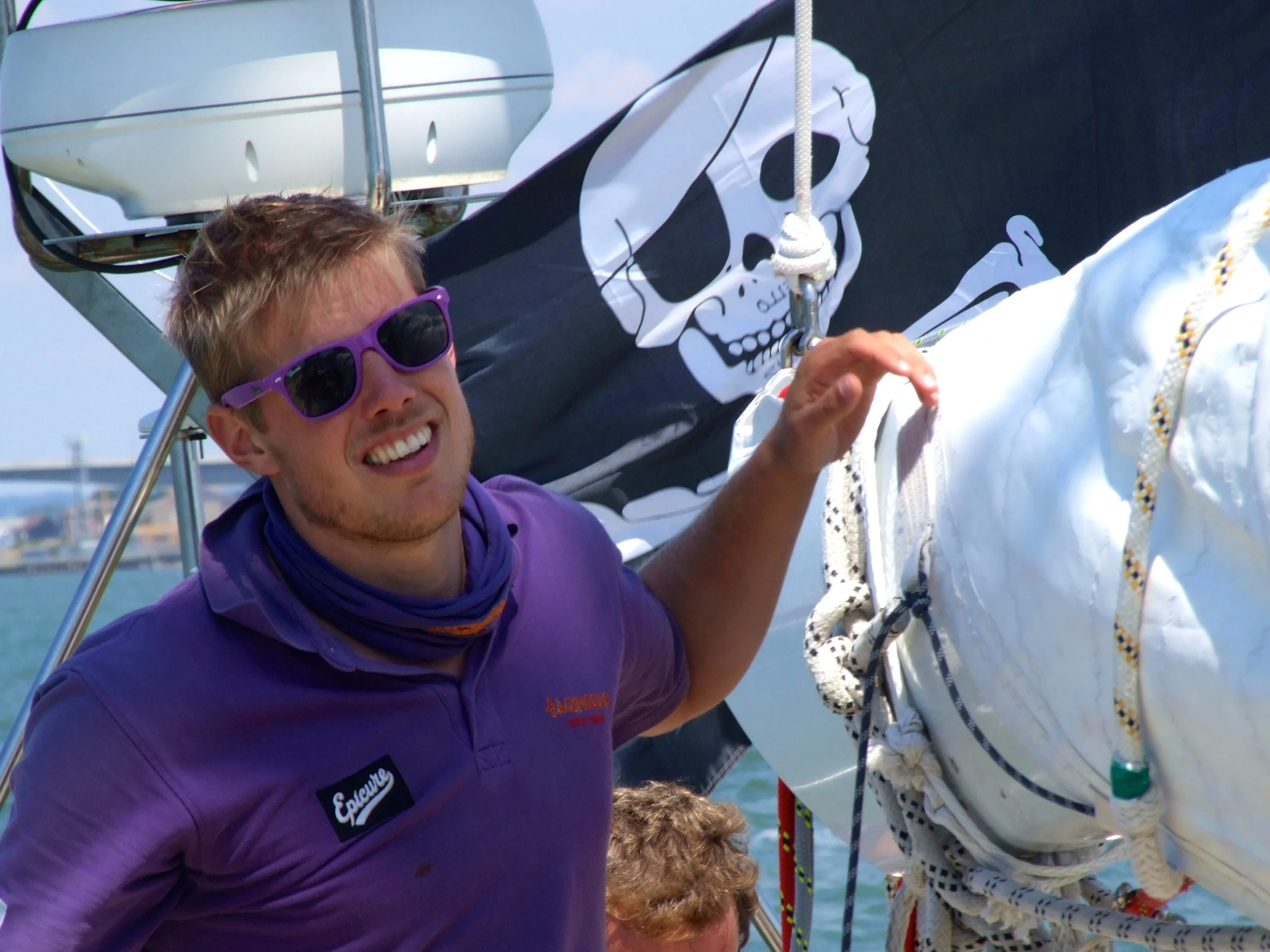
I gave a Ridge Talk, titled "Resilience, Patience and Adventure", for our Cotswold Creative Retreat in 2024. We explored why humans must willingly embrace hard things, discomfort, and risk rather than staying confined within safe comfort zones. Drawing from my own personal reflections from competing in an amateur round-the-world sailing race - where I faced brutal oceans, exhaustion, and extreme conditions - I know that personal growth, resilience, and patience are forged effectively through struggle. The full transcript is below and you can listen to it in full by clicking play.
Resilience, Patience and Adventure
Can you all think about something that you have done that you hard?
Why do we do hard things?
What can we learn from an experience that tests us? That makes us uncomfortable, or that may not have seemed so much fun at the time?
In the Autumn of 2011, I was somewhere in the Southern Ocean and this is how I felt:
“This is really tough. There have been hard times in this race already, but being so far behind and knowing we might face the prospect of another short stopover just when we really need the rest is beginning to take its toll. My own tiredness has seen me have a small moment in the galley. Swearing at the helm as we were hit by a wave and the oven doors flew open for the third time, sending potato wedges and oil flying. I’ve also noticed that other round the world crew members have been having their own little private moments. Fighting physical and mental demons as emotions, fatigue, frustration and the elements seem to get the better of them.”
Between the summers of 2011 and 12, I took part in an amateur round the world sailing race, 10 boats took on 8 legs, racing 14 times to complete one circumnavigation. We endured hurricanes, subzero temperatures, tropical heat and 100ft waves. And we all paid for the pleasure. Why?
In a world where there is constant competition for our attention, where we are in global competition for opportunities, and where the heights of what we might achieve literally climb into space, it is my belief that it is an important part of our brief earthly experience to be the very best that we can be. It is also my firm belief that we do not achieve that goal sitting in a comfy seat scrolling or immersed in our latest technological device, nor can we do that doing things that we already know we can do. We must become comfortable with being uncomfortable. At what points have any of you been uncomfortable whilst here?
When faced with a maths problem that requires effort, we should want to embrace that discomfort and be willing to take a risk to try something that might lead us to a dead end. Some sort of failure. And we must be comfortable with the idea that to fail is to achieve a first attempt in learning. If we never take that risk, if we stay within our comfort zone, then we discover anything about ourselves and what we might be capable of or not. Yet!
You have all proven that you are the kind of people willing to take risks, to set out on an adventure and embrace discomfort. Why put yourself through something difficult out of choice? Life can throw curve balls at you plenty when you’re not ready. Don’t fill time between crises with more difficulty! What do you think the benefit of such action might be?
We grow. We discover our limits. We surpass our own perceptions. We prepare ourselves for unwanted or unexpected discomfort that might be out of our control. We develop resilience. We exercise our patience. We realise that effort rewarded is effort well spent, and outcomes hard won taste all the sweeter for the bitterness of the journey. Just recently, my resilience was severely tested when I lost almost every penny that I had ever earned and my home along with it. To make things worse, it was partly due to decisions made by another close family member. Without having developed my patience, my acceptance of difficulty and my resilience to loss, this might have resulted in the end of my marriage, my being lost in a fog of anger and self pity and the breakdown of family unity. I am grateful to former versions of myself, and all the challenges I learned from for giving me the skills to save all those precious things.
Characteristics such as resilience and patience are as valuable during a big adventure, such as circumnavigating the globe, as they are during any shared endeavour in your daily life. Such as being paired up for a cleaning task. Finishing a fine piece of handcraft. Or even maintaining strong and healthy relationships with your peers. We’ve talked a lot about love and kindness these past few days: Sangeeta beautifully described how she cooks and feeds selflessly, getting up at 3am and cooking for 11 hours doesn’t sound like a cake walk; Makena discussed the risks she took to live a more kind existence; Emily spoke about the work she does, how she is passionate about it, but that it is not easy nor well remunerated. Being loving and kind is not easy, it takes effort and self-sacrifice. But, to quote Art Williams, US insurance executive, “I am not saying that it is going to be easy, I am telling you that it is going to be worth it.”
And so like all attributes that we can learn we should find ways to build them into one of our strengths. And whilst this can often be done in collaboration where appropriate, we must also appreciate the importance of each member of any community or team taking personal responsibility for engaging with their own struggle to achieve their best self. In order to make it look effortless, we must first put in the work.
You may have heard this before, but I think that this story makes for a beautiful analogy. A man found the cocoon of a butterfly. One day a small opening appeared, he sat and watched the butterfly for several hours as it struggled to squeeze its body through the tiny hole. Then it stopped; as if it couldn’t go further. So the man decided to help the butterfly, he took a pair of scissors and snipped off the remaining bits of cocoon. The butterfly emerged easily but it had a swollen body and shrivelled wings. The man continued to watch it, expecting that any minute the wings would enlarge and expand enough to support the body. Neither happened. In fact, the butterfly spent the rest of its life crawling around. It was never able to fly. What the man, in his kindness and haste, did not understand was that the restricting cocoon and the struggle required by the butterfly to get through the opening was a way of forcing the fluid from the body into the wings, so that it would be ready for flight once that was achieved.
Sometimes struggles are exactly what we need in our lives. Going through life with no obstacles would cripple us. We would not be as strong as we could have been and we would never fly.
I have asked for strength and life has provided me with hardships in order to make me strong.
I have asked for wisdom and life has provided me with problems to solve.
I have asked for prosperity and life has provided me with a brain and muscles in order to work.
I have asked for the capacity to fly and life has provided me with the obstacles to overcome.
I have asked for love and life has provided me with people to help in their problems.
I have asked for favours and life has provided me with potentialities.
I have received nothing of what I have been asking for, but received everything that I needed.
Live your life without any fear, within the clear conscious that everything works out for the best. Engage yourself with all the hardships that come to you and prove the fact that you are able to overcome them. You have succeeded in surviving anything that has been tough up until now, believe in yourself that you can do it again.
So finally let’s take in Eleanor Roosevelt’s words from You Learn by Living, eleven keys for a more fulfilling life:
“You gain strength, courage and confidence by every experience in which you really stopped to look fear in the face. You are able to say to yourself, I have lived through this horror, I can take the next thing that comes along. You must do the thing you think you cannot do.”